
Pizza is a universally beloved dish that often comes in a round shape. Yet, when delivered, these round pizzas are almost always nestled inside square boxes.
At first glance, this might seem like a curious inconsistency in design, but there are practical reasons rooted in manufacturing and functionality that explain why square boxes are the standard for round pizzas.
Square pizza boxes offer a myriad of benefits, including cost-efficiency in production and ease of storage and stacking.
The use of square boxes also simplifies the process of packing and removing the pizza without compromising its structural integrity.
When considering heat retention and air vents, which are crucial for maintaining the pizza’s quality during delivery, square boxes with thoughtful design can provide adequate ventilation and insulation.
Historical Evolution of Pizza Packaging
The journey of pizza packaging began with rudimentary and practical solutions.
Early iterations were simple paper bags, which offered some degree of warmth during transportation but little in terms of protection or heat retention.
With the advancement of materials, corrugated cardboard became the go-to, transforming how pizzas were delivered.
In the 1960s, an important development within the pizza industry emerged. Tom Monaghan of Domino’s Pizza fame is often credited with the invention of the modern pizza box which introduced not only a sturdier container but also a more efficient design for stacking and transport.
- Late 1800s: Pizzas primarily sold in slices, wrapped in paper.
- Early 1900s: Full pizzas transported in paper bags.
- 1960s: Development of the corrugated cardboard box.
The square shape of modern pizza boxes is a result of practicality—the boxes are easier to assemble, more economical to produce, and simplify storage. This design also allows for a consistent fit regardless of pizza size, cutting down on the number of different box sizes a pizzeria must keep in stock.
Additionally, the corrugated cardboard construction offers more than just protection against physical damage; it serves as insulation to keep pizza hot.
Innovations such as the plastic tripod, also known as a pizza saver, were added to prevent the topping from sticking to the lid, thus maintaining the aesthetic and quality of the pizza during its journey.
Design and Manufacturing of Pizza Boxes
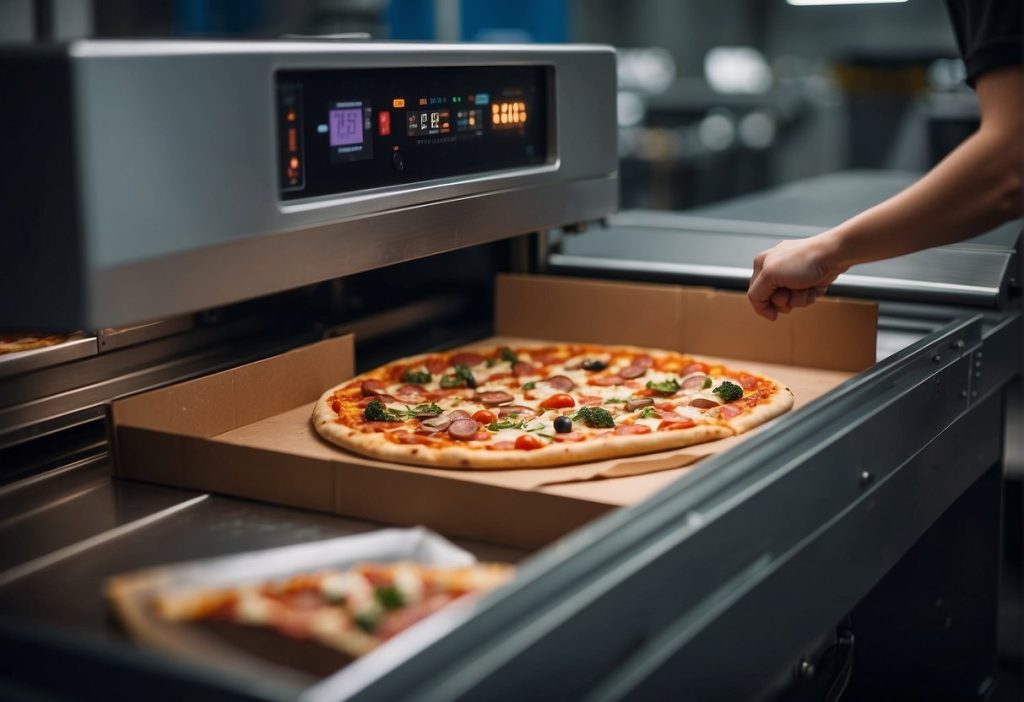
The process of creating pizza boxes combines practicality with material science, resulting in the iconic square box that delivers round pizzas worldwide.
From the selection of materials to the considerations of shape and engineering of the folding process, every aspect is designed with the end-use in mind.
Materials Used in Production
Pizza boxes are primarily manufactured using corrugated cardboard, which consists of three layers of paper that include an outer liner, an inner liner, and a fluted medium in between.
This construction is integral to providing strength and insulation.
Sustainable resources like sugarcane and bamboo are increasingly popular for creating compostable pizza boxes.
The Square Shape
Although pizzas are round, boxes are square due to several reasons.
Square boxes are cost-effective to produce, easier to store and stack, and more efficient during transportation.
The design also stems from the simplicity of creating a square box from a single sheet of corrugated cardboard, which cannot be as easily achieved with a round design.
Box Folding and Assembly Process
The manufacturing process of pizza boxes is streamlined to optimize for efficiency and scale.
The boxes are precut and scored to fold without the need for adhesives or tools.
They are delivered flat to the pizza shops, where they are easily assembled by hand, transforming into a sturdy container for the pizza.
Functional Reasons for Square Boxes
Square pizza boxes are ubiquitous due to several key functional advantages that cater to the needs of storage, transportation, and financial considerations in the pizza industry. https://www.youtube.com/embed/W63cPQH3HKc
Storage and Transport Efficiency
Square boxes are the go-to choice for efficiency in storage and transportation.
Pizzas are generally transported in bulk, whether in a delivery vehicle or on storage shelves.
The uniform shape of square boxes provides a means to neatly arrange and maximize the use of space, preventing wasted areas that would result from circular packaging.
Ease of Manufacture
Manufacturing square boxes is straightforward because they can be constructed from a single sheet of cardboard.
This simplifies the production process and results in a speedy assembly.
Square designs allow for quick folding and seamless glueing or locking of tabs, which is instrumental in high-volume pizza environments.
Stackability and Handling
The ability to stack is essential in the pizza business for both delivery and in-store operations.
Square boxes are designed to stack securely, reducing the risk of tipping or sliding, even during transit.
This stability is crucial for maintaining the quality of the pizza and ensuring that it arrives in optimal condition.
Cost-Effectiveness
Square pizza boxes are cost-effective to produce.
Resource utilization is optimized by minimizing excess material, which lowers production costs.
Moreover, the ease of manufacturing and the material savings are often passed on as savings to the pizza businesses, making square boxes a financially sound choice.
Consumer Convenience Factors

Square pizza boxes serve specific purposes in enhancing consumer convenience. They address ease of use, storage, and disposal concerns.
Ease of Pizza Removal
The design of square boxes allows for ample space around the circumference of a round pizza, facilitating easier removal.
This extra room reduces the chances of damaging the pizza when taking it out of the box, ensuring that the consumer can enjoy a perfectly intact pizza.
It is particularly beneficial in preventing the topping from sticking to the lid, a common issue with tighter packaging.
Disposal and Recycling
As for disposal and recycling, the square shape proves to be more efficient.
Square boxes can be broken down flat without difficulty, streamlining the recycling process.
Furthermore, this shape stacks neatly, which is an advantage not just for the suppliers during transportation but also for the consumers when they need to dispose or recycle multiple boxes at once.
Aesthetics and Branding

The design of pizza boxes isn’t solely for functionality; aesthetics and branding are crucial components. These aspects significantly influence consumer perception and brand identity.
Surface Area for Branding
Square pizza boxes offer an ample surface area for companies to print logos, promotions, and other marketing materials.
This increased space allows for more creative designs that can be seen on the top, sides, and even inside of the box, making them effective tools for advertising and brand recognition.
Visual Appeal
The visual appeal of a square box enhances the presentation of the round pizza inside. This creates a contrast that is pleasing to the eye. This distinct shape can also make the pizza box and the pizza more memorable to the consumer. It embeds the brand into the customer’s mind.